

Mississippi Native: Jack Elliott
"Home is a microcosm, the center of a wheel with spokes radiating out to a periphery, and the spokes are the connections that link home to the cosmos..."
What does it mean to call Mississippi home? Why do people choose to leave or live in this weird, wonderful, and sometimes infuriating place? Jack Elliott thinks a lot about his connection to place. The place, where Jack has lived for most of his seventy-two years, is Palo Alto, Mississippi, now an extinct town founded by Jack’s great-great-grandfather. As a child, Jack unearthed untold historical artifacts in the family garden and surrounding land, relics of the ancestors, native communities, and prehistoric creatures that once called this place home. This curiosity of what-came-before eventually led to his twenty-five year career as a historical archeologist with the Mississippi Department of Archives and History. There he uncovered the historical significance of Natchez’s Fort Rosalie in what led to the creation of the Natchez National Historical Park. Today, Jack reflects on the transcendent nature of home that he’s gleaned from a lifetime of being rooted to place.
Where are you from?
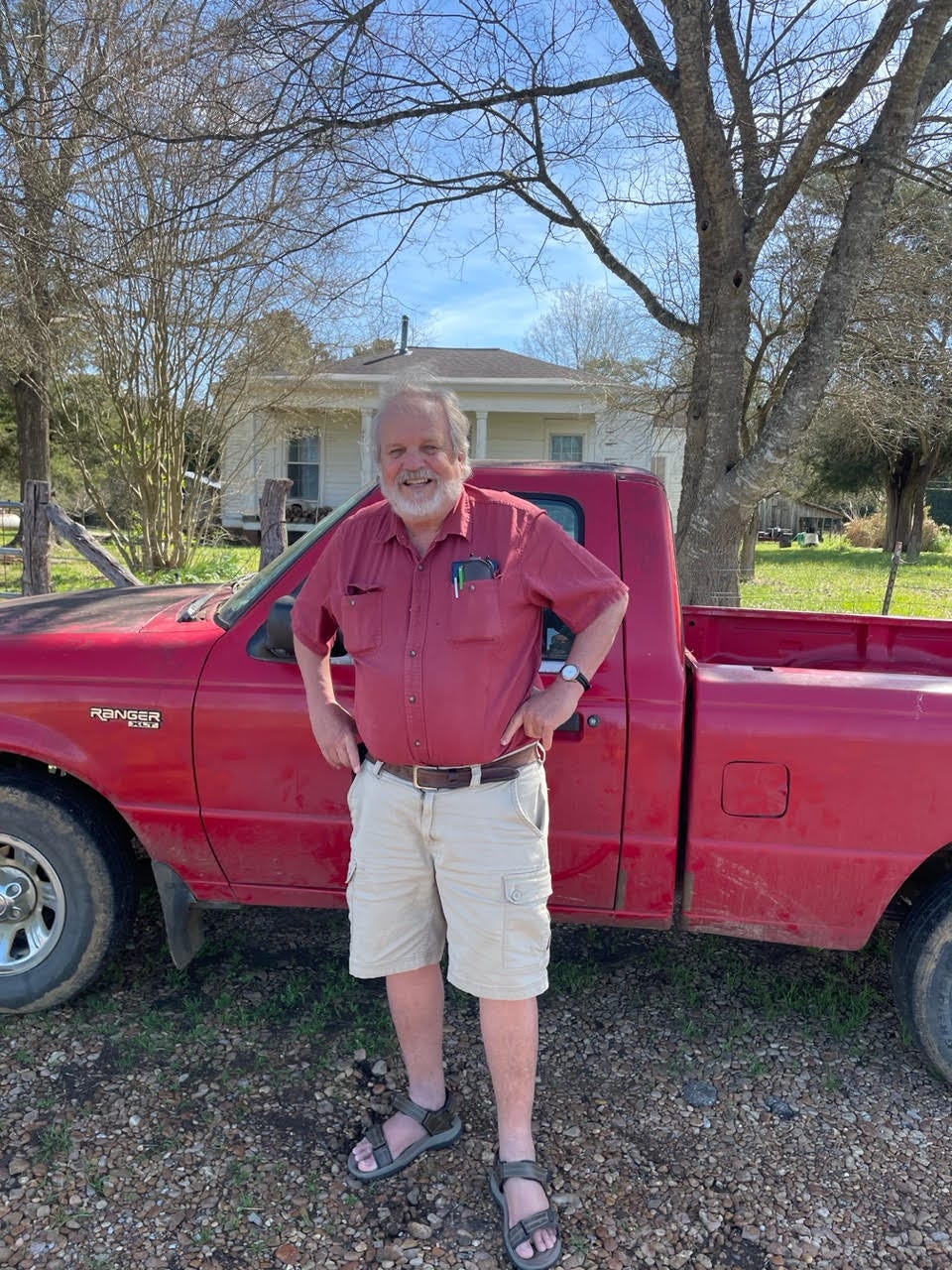
My story might appear a bit unusual. I live in a Greek Revival cottage in the middle of a cow pasture at Palo Alto, Mississippi, an extinct town that was founded by my great-great-grandfather Daniel B. Hill who came there in 1846 to operate the first store, post office, and hotel before graduating to country doctor a few years later. To put this in a geographical perspective, Palo Alto is in northeast Mississippi between Houston and West Point. I reside there with my wife while our sons reside nearby with their families. During my lifetime the Palo Alto area has transitioned from cotton and dairy production to beef cattle production.
How long have you lived in Mississippi?
I’ve lived most of my seventy-two years in Mississippi, except for a few years in Austin, Texas, and Israel. Today I reside and have resided since birth at Palo Alto where my family has lived since 1846 when my ancestors first arrived. This gave me an exceptional identification with the land and people of the area. Located next to our home, my father ran a country store that was founded in 1906. Growing up around the store I often clerked for my father and quickly came to know our neighbors, both Black and white, poor and middle-class, who would come by the store to purchase everything from a Coke to grocery supplies. Through talking to them I came to know their stories and how they fit into the larger historical tapestry of which I was a part.
What does “home” mean to you? How does Mississippi fit into that definition?
The question “what does home mean?” is deeper and more nuanced than one might expect. For me it requires reflection upon a lifetime and the things and people that have encompassed it in Mississippi and other places. Home is closely related to our sense of meaning, of being rooted in a place from whence you have a perspective on life, a sense of identity, and responsibility. In reflecting on home, I recovered an old but often forgotten dimension, namely “sacramental reality” where the material world is seen as a sign, of an invisible Transcendent world that is ultimately a mystery. In contrast, modern society sees the world as disenchanted, consisting of only a collection of meaningless matter. In these terms, one can’t even begin to define home.
My home at Palo Alto consists of a few houses (including my own) and the family store (now closed after over a century of operation), all surrounded by pastureland. At least this is the outward appearance. Overall, this constitutes a pleasant, welcoming scene but nothing out of the ordinary. Yet there is more, as gradually became manifest.
At an early age I experienced the indescribable. I was walking across our yard between the store and the house, when it dawned on me that I was four years old. This was far more than an awareness of mere age. It was something that I could not articulate. It was an awareness that I existed and that the world existed. It left me with the impression that the world as perceived was only a surface that veiled something unseen to which we were all dependent.
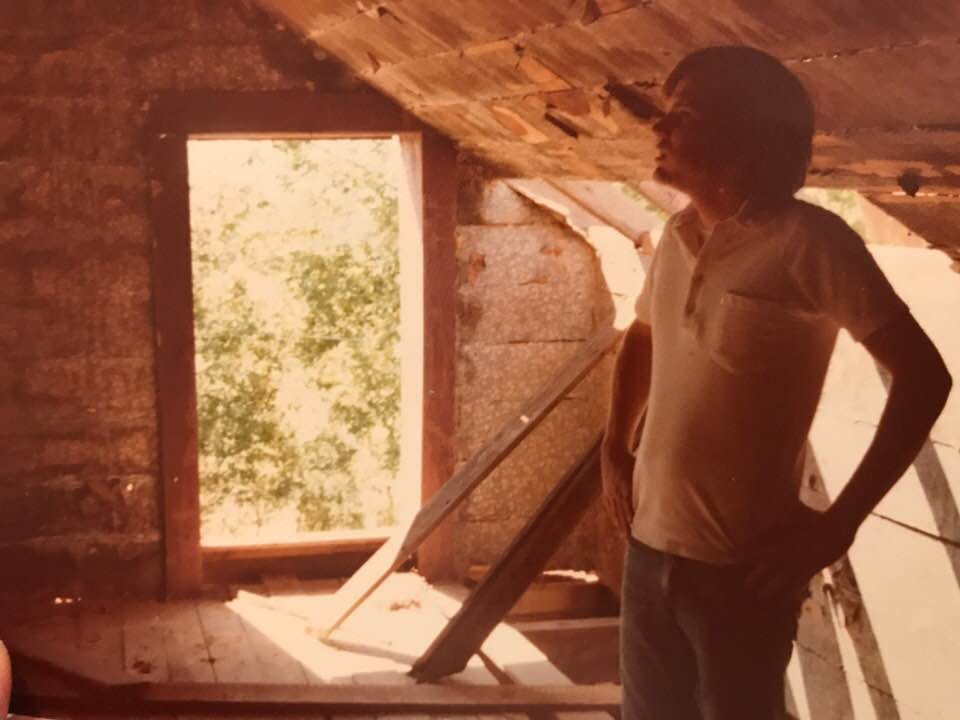
Early in life, I noticed that after our garden was plowed, the rains uncovered numerous artifacts, broken ceramics and glass, square cut nails, and other things, including a small iron, probably a toy owned by some little girl, probably a family member, but by then long dead. The presence of these things raised questions about their origin. My father explained that our family had lived at the same house site for over a hundred years. In fact, the first house that stood on the site was a log house—the home of my ancestor Daniel Hill—and that a small town had once existed, then flourished for a short time, then was abandoned. Any excavation in the yard would invariably reveal artifacts of a bygone time. A sunken roadbed in our pasture was revealed to be an abandoned street in Palo Alto. I began to see the land differently, as the result of stories told by my father and others. Everything was revealed to be overlain by an antiquity that merged with the larger story of the settlement of the West, of pioneers in covered wagons founding towns and farms.
Home is a microcosm, the center of a wheel with spokes radiating out to a periphery, and the spokes are the connections that link home to the cosmos that is ultimately shrouded in the mystery that transcends all.
Near home I discovered remains of Indian settlements, one about 500 years old while another was much older at about two thousand years. And I could go even deeper. There were also chalk gullies, eroded remnants of a 70-million-year-old sea floor. Fossil shells littered the ground in thousands while shark teeth and bones of aquatic reptiles were also present. This served as an ever-ready source of imagination through contemplating such a remote past which nevertheless seemed so near as witnessed by the fossils. All such remains suggested that my world at Palo Alto was but a window into something bigger.
I was especially fascinated by the old livery stable cistern, a feature that would bring me to contemplate the mystery that lies behind everything. The stable had disappeared the better part of a century before, but the associated cistern remained. Cisterns are large holes excavated in the ground to trap and store rainwater from rooftops. While their necks were only about three or four feet in diameter, underground they were much wider, so as to be able to store a large volume of water. Most had been filled in long before my time; during my childhood, only this old cistern remained open, and it had become something of a local legend. According to the stories, it was so large that before being filled with water, residents climbed down into it to hold a dance. On several occasions I climbed over a fence and struggled through the grass and brambles to reach the lonely cistern. There I would stare down at the surface of the dark water. In the quiet, I could almost hear the sound of fiddles and dancing feet from some long-gone Palo Alto evening. The dance could well have happened, but then it may not. Regardless, in my mind it took on a mythical quality.
The cistern pointed beyond itself to something mysterious that could not be fully comprehended. I was forcibly reminded of Thomas Mann’s image of the past as a well: “Very deep is the well of the past. Should we not call it bottomless?” The past represents the dimension of mystery in human existence, something both near and remote, partially comprehensible yet ultimately ineffable. Mann continued: “For the essence of life is presentness, and only in a mythical sense does its mystery appear in the time-forms of past and future. They are the way, so to speak, in which life reveals itself to the folk… Thus speaks the myth, which is only the garment of the mystery.”
The paleontologist Loren Eiseley had similar insights. Growing up a lonely, introspective young man, he spent much of his life looking for fossils of extinct life in eroded badlands. As he grew older, he began to understand that there is a mystery in the world that cannot be reduced to scientific description. He noted that this mystery “led Hudson to glimpse eternity in some old men’s faces at Land’s End, that led Thoreau to see human civilizations as toadstools sprung up in the night by solitary roads, or that provoked Melville to experience in the sight of a sperm whale some colossal alien existence without which man himself would be incomplete.” Such intimations led to an awareness of that which transcends the material.
For each question I had about the things around me there were answers. But in each case the answers actually revealed more, opening endless horizons.
The things around us along with associated stories and memories link us to the larger world of Creation. My house, my home, surrounded by shade trees stands in the middle of a pasture. But there is more. For there are also my family and neighbors, people that I have known for years. For them I feel responsibility, and if I fall, I know that they will pick me up. So, home is more than simply a window to something larger; it is also part of an interconnected community that I would give my life to defend.
Home is a microcosm, the center of a wheel with spokes radiating out to a periphery, and the spokes are the connections that link home to the cosmos that is ultimately shrouded in the mystery that transcends all. This intangible dimension of meaning is what distinguishes a mere house from a home. In this way, my home opened a sacramental vision. Home is—to recall Mann’s words—“only the garment of the mystery.”
How have you cultivated community in Mississippi? Who are the people who have made you feel rooted here?
For a large part of my life, I have had a privileged perspective from whence to view Mississippi and its communities. Working as historical archaeologist with the Mississippi Department of Archives and History, I was involved with identifying and preserving historic sites and buildings across the state. As a result, I gained considerable insight into the historic properties that in part defined Mississippi along with the communities that did the defining.
During this time, the accomplishment of which I am most proud was identifying the site of Fort Rosalie in Natchez on the high bluff above the Mississippi River along with uncovering its significance as the birthplace of the State of Mississippi. Previous historians had only focused on one occupation of the fort, usually the French occupation, and had failed to take into consideration its full eight-decade-long history. Beginning as a rude palisade in the wilderness, it was occupied by successive French, British, Spanish, and American garrisons while around this small center grew up the town of Natchez and the Natchez District from which emerged the State of Mississippi.
The fort site is to Mississippi what Jamestown and Plymouth are to the United States. My work promoting the site began a movement that created the Natchez National Historical Park.
Working across the state with individuals and historical societies, I provided advice concerning the history and archaeology of their communities. During this time, I met some of the best people in Mississippi, and they often invited me to stay in their homes while I was working in their area. This resulted in many long-term friendships and gave me an insider’s view of their communities. One thing that became evident was that their love of history and place was linked to their love of community and home. I intuited in them a subliminal sacramental vision that was seldom able to surface in consciousness.
I was born and raised in Mississippi, rather than another place, and consequently feel that I owe much to the people and places that formed me.
Years of working in this area gave me much time to reflect upon the nature of our experience mediated as it is by stories and the ensuing sense of mystery. Unfortunately, historic preservation is defined in terms of the material, “saving old stuff.” I realized that there was more. I could see this in the numerous people that I’ve worked with across the state who were concerned about the physical landscape and its interplay of history and memories. For them home involved something that they couldn’t quite define, a mixture of buildings and people that served as the backdrop of their existence.
However, the regulations that our agency was based on promoted little more than the material aspects of saving old stuff. Among the professionals who worked according to these regulations and who were effectively charged with interpreting history to the public, little thought was given to the sacramental aspects that are at the roots of interest in this.
What’s the weirdest question or assumption you’ve encountered about Mississippi (or about you as a Mississippian) by someone who’s never been here?
Most of my life I have occasionally encountered people who fancied themselves to be “liberal,” that is open minded, yet through their unguarded comments made it clear that they considered Mississippians to be ignorant and bigoted. Although this was far too common to be considered “weird,” what does qualify for the term is the irony of the situation, in which such “liberals” were actually quite “illiberal,” in their provincial ethnocentrism.
What is something that you’ve learned about Mississippi only by living here? In what ways has Mississippi lived up to your expectations?
I’ve already sketched out what I’ve learned by growing up in Mississippi. In many ways I could have learned the same in other states and countries. It only required the drive to think without regard to the social pressures that channel one’s thought into more materialistic avenues. Nevertheless, I was born and raised in Mississippi, rather than another place, and consequently feel that I owe much to the people and places that formed me.
Do you ever consider moving away someday? Does a sense of duty keep you rooted here? Do you have a “tipping point”?
While social and economic forces encourage mobility and thereby a breakdown of the sense of home and community, I have tried to resist these pressures and maintain a sense of home that I could pass on to my children and grandchildren. In doing so, I have tried to provide them with roots that link them to something bigger than merely the individual pursuit of increased economic productivity and maximum consumption.
What do you wish the rest of the country understood about Mississippi?
If you see a quote by Mississippi’s greatest writer William Faulkner, it’s likely to be: “To understand the world, you must first understand a place like Mississippi.” It will probably come as a surprise to hear that he probably never said that. Which is not to say that the statement has no validity and is not characteristic of his thought. I’ve already noted that my home served as a microcosm in understanding the greater cosmos, so I could well insert Palo Alto into the quote, instead of Mississippi, or anyone else could insert their own home or state or country.
The things around us along with associated stories and memories link us to the larger world of Creation. My house, my home, surrounded by shade trees stands in the middle of a pasture. But there is more. For there are also my family and neighbors, people that I have known for years.
Do you have a favorite Mississippi writer, artist, or musician who you think everyone needs to know about?
Without a doubt that would be William Faulkner. Through his novels and short stories about his fictional Yoknapatawpha County, Mississippi, he brought the land and history of north Mississippi to life as literature. He famously recalled discovering that his “own little postage stamp of native soil was worth writing about,” and from there he took the people and places and transformed them through his imagination. I could certainly identify with this. I began to see everything about me as being transformed through story. This emphasized my growing understanding that to a large degree life is communicated to us through story . . . “in which life reveals itself to the folk.”
In his novel The Town, we ride with the attorney Gavin Stevens to a high ridge overlooking Yoknapatawpha County. There we listen to his sacramental ruminations regarding his connectedness to the land and its people:
And now, looking back and down, you see all Yoknapatawpha in the dying last of the day beneath you. And you stand suzerain and solitary above the whole sum of your life... First is Jefferson [the county seat], the center, radiating weakly its puny glow into space; beyond it, enclosing it, spreads the County, tied by the diverging roads to that center as is the rim to the hub by its spokes, yourself detached as God Himself for this moment above the cradle of your nativity and of the men and women who made you, the record and chronicle of your native land proffered for your perusal in ring by concentric ring like the ripples on living water above the dreamless slumber of your past.
These words express a vision of connection to home and place. The image of “the center” linked via “diverging roads” to “the rim of the hub” is evocative of my image of home as the center of spokes in a wagon wheel.
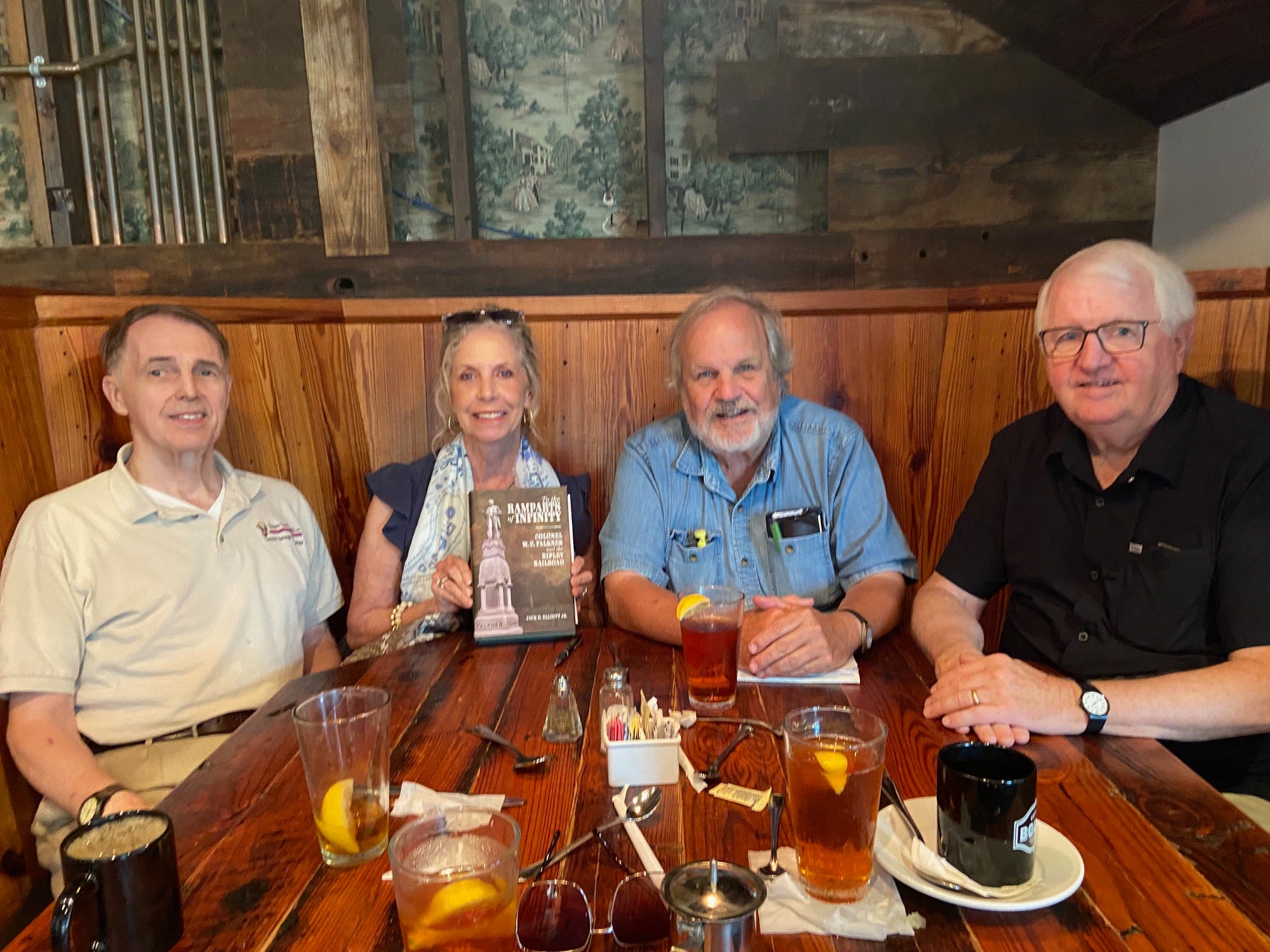
My interest in Faulkner and his Yoknapatawpha County eventually led to my researching, writing, and eventually publishing a biography of the writer’s great-grandfather, To the Ramparts of Infinity: Colonel W.C. Falkner and the Ripley Railroad (University Press of Mississippi, 2022). Colonel Falkner served as an early influence on his descendant, who used the Colonel as the prototype for one of the key figures in Yoknapatawpha County.
If you had one billion dollars to invest in Mississippi, how would you spend your money?
I’m afraid that if someone gave me a billion dollars, I would be set upon by every smooth-talking grifter in North America.
Nevertheless, I would attempt to expand horizons to see beyond the materialistic (and therefore implicitly atheistic) horizons in which we are schooled. Although training for jobs is essential, there is more to life than this, and people should minimally be aware of it. Society must have a greater vision that sees life in all of its dimensions, one that learns from the past in preparation for the future.
Jack Elliott has lived most of his life on the site of the extinct town of Palo Alto, Mississippi that was founded by his family in 1846. The experience of history and place has given him a strong interest in the historical geography of his area and the personal connection to historical places. Work in the Holy Land beginning in 1977 has reinforced his interest in the experience of place, in specific with the Christian shrines of the Holy Land. Jack is retired as historical archaeologist with the Mississippi Department of Archives and History (1985-2010), in which capacity he identified the site of Fort Rosalie and began the political effort that led to the establishment of the Natchez National Historical Park. He also taught archaeology, geography, and religion as an adjunct at the Meridian campus of Mississippi State University (1988-2016). He currently resides in a Greek Revival cottage in the middle of a cow pasture at Palo Alto along with his wife, four dogs, five cats, and a varying number of chickens.
One year ago:

Two years ago:

Three years ago:

What a beautiful contemplation of the layers of history and the non-material as well as material components of historic preservation! I loved his story about the dance in the cistern, and the idea of answers to questions always revealing yet more questions, and the way he brings in Thomas Mann (the bottomless well, the “garment of the mystery”). So much to consider here!