

Casino Lights
W. Ralph Eubanks on the promise—and failure—of casino gambling to lift Tunica, Mississippi, out of poverty
The following essay is excerpted from W. Ralph Eubanks new book When It’s Darkness on the Delta: How America’s Richest Soil Became Its Poorest Land. Attend a reading and get a signed copy at a bookstore near you. Ralph will be making the following appearances: Square Books (Oxford, MS): January 13th, 5:30pm, with Wright Thompson; Lemuria Books (Jackson, MS): January 15, 5pm, with Betsy Bradley; Pass Christian Books (Pass Christian, MS): January 30, 6pm. We’ll be featuring When It’s Darkness on the Delta as our February Bottom Reader Book Club pick.
If you drive north from Clarksdale on famed Highway 61, you’ll run into the Delta town of Tunica. Tunica sits just thirty miles south of Memphis, Tennessee, yet it stands a world apart from the world of the Bluff City. Delta writer David Cohn famously said that the Mississippi Delta began in the lobby of the Peabody Hotel in Memphis: “If you stand near [the hotel’s] fountain in the middle of the lobby, where ducks waddle and turtles drowse, you will see everybody who is anybody in the Delta.” During my childhood travels around the Delta, Tunica and its environs always felt like the end of the Delta; in comparison, the streets of Memphis felt foreign and otherworldly. Perhaps that is because as a child, I found the fields in and around Tunica to be so vast, almost limitless. Arriving in Memphis and confronting its urbanity meant leaving behind the Delta’s limitless flatness and expansiveness. Memphis too was a Southern space, but for me it stood apart from the Delta rather than being a part of it.
In Cohn’s statement, one can see how perspective works in the Delta. If you are a planter, Memphis is a place of beginnings associated with prosperity, a place to be seen a certain way by one’s peers. Those who work the fields may never leave Tunica for Memphis, except on a passage further north to Chicago. For one group, Memphis feels like a paradise to display one’s wealth and standing by being seen in a lush hotel lobby with a twice-daily procession of ducks. For another, Memphis is a path that leads to a possible escape from poverty and penury.
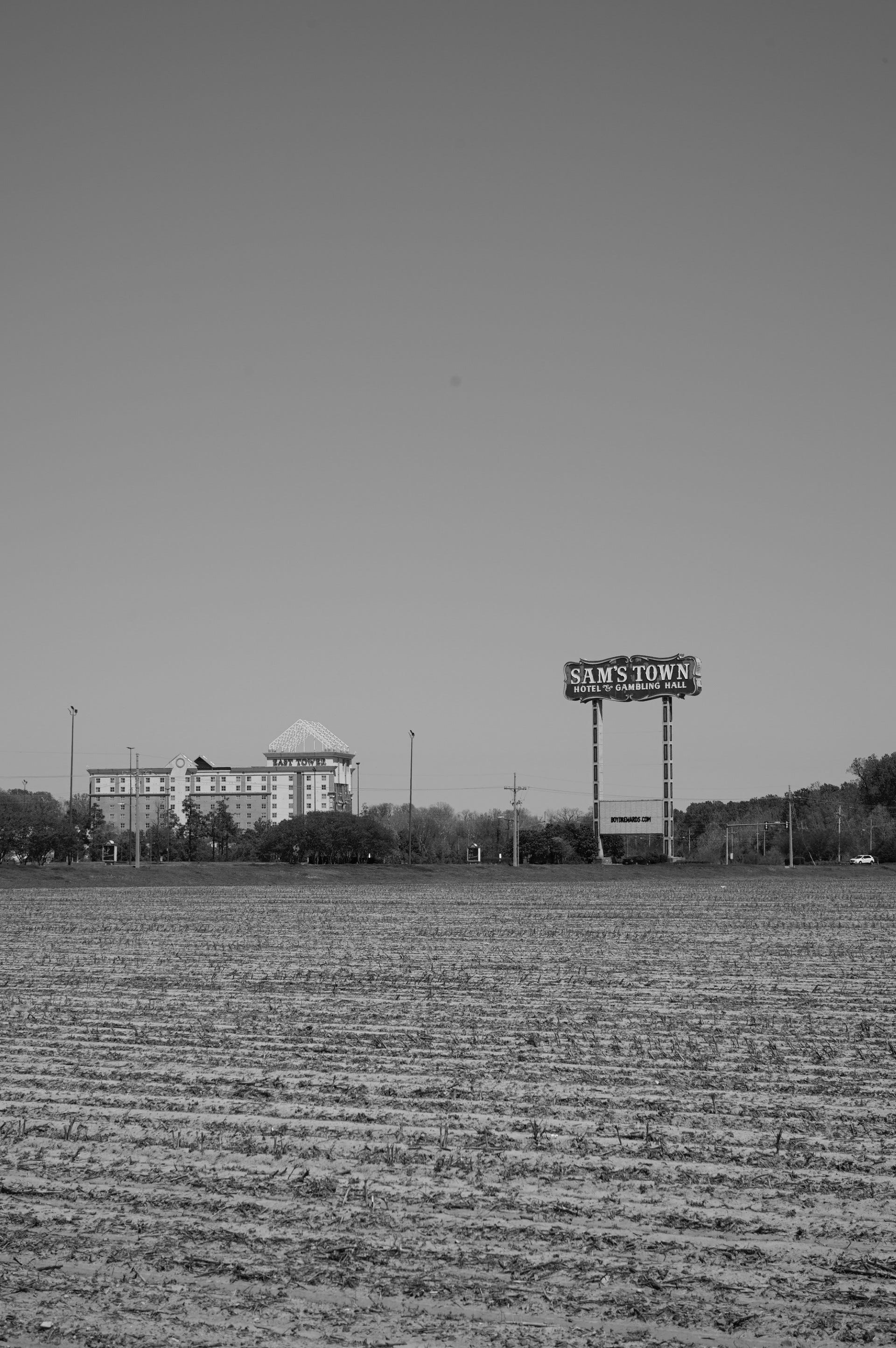
Like much of the Delta, Tunica is home to vast fields planted in cotton, rice, and soybeans, with a few commercial catfish ponds dotting the landscape. Tunica’s boundless agricultural expanses, like all of those in the Delta, were created by clearing the land of a jungle-thick covering of trees. Tunica also stands at a bend in the Mississippi River that has changed its course so often that what was once Mississippi shore a century ago is now Arkansas territory. Now a new created environment has been placed on top of the one created at the turn of the nineteenth century. Across the vast fields that stretch to the Mississippi River levee stand tall hotel casinos that look like they belong on the strip in Las Vegas. The Hollywood Casino and Sam’s Town are separated by both a boulevard and a field planted in cotton, corn, or soybeans, depending on the year of crop rotation. It is an odd juxtaposition, as if somehow the lobby of the Peabody has been displaced to the Delta, yet without the status and grandeur. These huge placeless spaces have been plopped onto an environment created by humanity, as well as time and the Mississippi River. And there are no ducks in the lobby, only the smell of stale cigarette smoke wafting its way from the floor of the casino.
The tall buildings and bright lights are new to this part of the Delta, something bluesman Robert Johnson could not have imagined when he was growing up on the Abbay and Leatherman Plantation down the road from where the casinos now stand. For more than thirty years, Tunica has embraced the gambling Johnson captured in his song “Last Fair Deal Gone Down,” a work song that tells the story of gambling and romance on the Gulf and Ship Island Railroad. “If you cry about a nickel, you’ll die ’bout a dime,” Johnson once sang in a high and expressive voice. Unlike the Delta, the Mississippi Gulf Coast long had a culture of gambling, albeit illegal gambling for much of the twentieth century. Now the gambling games of Georgia Skin that were played on the railroad cars Johnson sang about—whether bound for the Gulf or in transit to the coast—have come to the plantation land where he spent his youth, if in a more comfortable and sophisticated setting.
The tall buildings and bright lights are new to this part of the Delta, something bluesman Robert Johnson could not have imagined when he was growing up on the Abbay and Leatherman Plantation down the road from where the casinos now stand.
When civil rights activist Jesse Jackson visited the Delta town of Tunica in 1985, gambling was the last thing on his mind. Instead, he rallied its residents by acknowledging that their town was a place that had “dropped out of the bottom of [President Ronald] Reagan’s safety net.” Jackson said he was “disappointed about the collapse of government at all levels on the problems of these people.” In front of a packed audience at Rosa Fort High School, Jackson led the crowd in chants of “War on poverty!” and “I am somebody!”—the latter one identified as Jackson’s signature.
Five US congressmen accompanied Jackson and pledged to help the community move forward with legal help and college tuition assistance. Few remember that promise. But what everyone remembers is that Jackson proclaimed the town of Tunica to be “America’s Ethiopia” because its poverty and lack of electricity and indoor plumbing were more akin to the living standards found in a country overtaken by war, famine, and natural disaster. The Black community of Kestevan Alley—otherwise known as “Sugar Ditch”—became a focus of national attention because of reports of hunger and parasitic and bacteriological infections. What had earned the neighborhood its nickname was not sugar but raw sewage, since many residents had no sewer connections. People lived in collapsing shacks filled with vermin. The poverty rate of the county was then 56 percent. When CBS’s 60 Minutes visited Sugar Ditch in 1985, reporter Morley Safer compared it with South African townships, noting that the only difference was that in Tunica “apartheid is there for all Americans to see.”
Nearly a decade later, casinos and gambling were introduced as a commercial force that would save the Delta economy. Legal gambling came to Tunica County in the early 1990s bringing the promise of prosperity to an area known for its extreme poverty and racial segregation. Gambling came to the Mississippi Gulf Coast as well. But over twenty years after the casinos opened, the gambling landscapes of the Gulf and the Delta are completely different. Gulf Coast casinos merely made legal what was once illegal and were compatible with a place that already had a culture of resort vacationers. Constructing casinos in Tunica was a way to create a new resort and resort culture, built on the romance of the Delta and the Mississippi River, with its connection to riverboat gambling in the early twentieth century.
Gambling traditionally took place on Mississippi riverboats to avoid anti-gambling laws in Mississippi and other states along the river. Now, the gambling could take place on land, free of restrictions and with the generated tax revenue going to Tunica County. The advent of casinos in Tunica was also pitched as a way out of poverty for the region’s residents, as if the money that bettors gambled would magically materialize into jobs. But the advent of casino gambling has not completely lived up to its promise. The county’s unemployment rate in July 2024 was 4 percent, fairly average for Mississippi. Even with revenues of roughly $759 million from casino gambling, a county that ranked among the nation’s poorest in the 1980s still has roughly a third of its residents living in poverty. The people who lived in the infamous Sugar Ditch may now have indoor plumbing, but they are not much better off economically than they were when Jesse Jackson visited in 1985.
Mississippi writer Kiese Laymon famously remarked that “no meaningful promises are made or kept in casinos.” If you look at Tunica today, you understand exactly what he means. The promise that gambling could create an economic miracle and transform Tunica was based not on sound planning, nor was it a promise that could ever be realized. Today, Harrah’s Casino is shuttered and empty, a victim of the Great Recession of 2008. Thick blades of grass poke through holes in its now-empty asphalt parking lot. The building that once housed the headquarters of Mississippi’s Casino Gambling Commission is scheduled to be demolished. Sam’s Town has demolished some of its hotel space since it was not being used. Wind farms are being constructed to compensate for the tax revenues that casinos are no longer bringing in. The shining buildings that remain represent only the prospect of an economic miracle, not evidence of one.
Mississippi writer Kiese Laymon famously remarked that “no meaningful promises are made or kept in casinos.” If you look at Tunica today, you understand exactly what he means.
Tunica’s approach to its decisions about casino gambling was akin to a cotton farmer speculating on his next crop, albeit with a little less precision. Cotton farmers calculate their profits based on the expected price, expected yield, and the number of acres planted, but in the end what they do is play the odds that in one year cotton might be more profitable than another crop, such as corn or soybeans. It seems as if in Tunica, the back-of-the-envelope calculation on long-term profitability of casinos was based more on irrational exuberance than a well-thought-out calculus. This poor county in the Delta believed that casino gambling would put it on an upward trajectory that would change its tragic moniker from Little Ethiopia to Little Las Vegas on the Mississippi Delta. The land itself is still being farmed for cotton, soybeans, and corn, which I see as a sign that those who leased land to the casinos were not willing to give up all their land on a risky bet. They knew that one day someone would have to pay up when that marker came due, though seemingly no one else took the odds into account.
Alongside Highway 61 stands a Tunica welcome center that is steeped in the culture and artifacts of the blues. The rustic-looking wood building and its neon signage are intended to evoke the feel of a Delta roadhouse juke joint. It is a sign that this part of the Delta thought it was going to turn a corner that combined blues tourism with gambling. Instead, what it found was that you can’t compartmentalize poverty into an economic or cultural box, add a new entity into the mix, and instantly expect things to change. It is impossible to determine the manner in which a region’s path out of poverty might unfold in particular contexts and conditions over time. Or how that supposed train to prosperity might come to a screeching halt.
Randall Towns doesn’t remember Tunica without casinos. He was born in Clarksdale in 1990, the year the state legislature legalized casino gambling in Tunica, and was two years old when the first casino opened. At the age of seven, when his family moved to Tunica, the casinos were fully operational and were still expected to be the driver for a new economy in the Delta.
I met Towns outside the Tunica History Museum, where he is a maintenance worker. On the day we met, I had come to visit the exhibitions at the museum, which I remembered from a previous visit. When I found the exhibition space locked, he kindly informed me that the facility was under renovation. Unable to gather the history of Tunica from the museum walls, I improvised and he agreed to tell me about how he sees the impact the casinos have had on the town he calls home.
“I grew up gambling, that’s why I still gamble at the casinos,” Towns tells me with some pride in his voice. He grew up in a single-parent household where, he said, “I essentially raised myself.” After getting kicked out of school in the eleventh grade, he was sent to the Oakley Training School, a juvenile justice facility run by the Mississippi Department of Corrections. After getting his GED, he tells me he “got baptized and found God.”
Like many Black Tunica residents, Towns doesn’t think the casinos have changed the town for the better. “Casinos have run this town dry. You can’t even find a quarter on the ground,” he tells me. When I ask him what he means by that, he says, “This is a town where a lot of people need help. The casinos were supposed to change this town, but they didn’t.”
Much like David Cohn’s idea of where the Delta begins, the feeling about whether Tunica’s experiment in casino gambling is a success is a matter of perspective. For Black residents, the amenities that came to the community from the casino’s tax revenue—such as the museum where Towns works, an Olympic-sized swimming pool, and a professionally designed golf course—don’t really benefit them. When I ask Towns if he uses any of these facilities, he says he doesn’t but points out they are open to all.
Yet he does agree with me that the spending from the tax revenue has not benefited working-class people like him.
Even with the presence of casinos, Tunica County has a poverty rate of 31 percent, a little over half of what it was during its days of being labeled “America’s Ethiopia.” As the Washington Post reported in 2015, of the hundreds of millions of dollars that Tunica earned from gambling between 1993 and 2015, just a tiny bit—about 2.5 percent, according to county records— was used on social programs to help county residents who live in poverty. While county leaders thought casino gambling would allow this very poor region to catch up, they underestimated the depth of the poverty that exists here. Tunica may no longer be America’s Ethiopia, but it is still much like the rest of the downtrodden Delta in its concentration of Black poverty.
At 31 percent, Tunica County may have a lower poverty rate than other counties in the Delta, but it is still more than double the national poverty rate.
To begin the casino gambling experiment in Tunica, the political class had to convince the landowners that they would benefit from this new revenue source. Since the vast majority of local landowners are also descendants of the county’s plantation class, they owned much of the land in the county and many lived in the separately incorporated town of Tunica, which has a vibrant and well-maintained downtown, unlike many in the Delta. The town of Tunica and the county exist in separate municipal realms, yet poverty infringes on both places. For example, what was once known as the “Sugar Ditch” is inside the city limits of Tunica. Yet quite a few of the landowners who lived in the town of Tunica were already wealthy, having inherited their wealth from parents, grandparents, and great grandparents, but, given the decline in the cotton industry, the members of this landowning class were not building new wealth. In the Delta’s past, this would have been the group resistant to bringing in a new form of industry. But they did not resist this time, perhaps because they stood to make millions of dollars selling and leasing their land in the county to the casino industry.
In the first decade of the casino’s existence, Tunica had an abundance of jobs and unemployment dropped to 4 percent. Yet its residents only moved from being the unemployed poor to being the working poor. At 31 percent, Tunica County may have a lower poverty rate than other counties in the Delta, but it is still more than double the national poverty rate.
During the boom times, Tunica County moved to slash property taxes to the lowest level of any county in the state, an overture to businesses and investors. Once again, the beneficiary was the wealthy landowner. But now the casino boom is over. Harrah’s Casino has been demolished, and the county has been looking to repurpose the long-vacant hotel portion of the property. In the spring of 2024, county officials considered a proposal for repurposing Harrah’s Hotel, as well as another hotel called The Veranda, as a facility to house unaccompanied migrant children. The proposal was met with some opposition, but the fact that the proposal was even considered indicates that Tunica’s days as a tourist destination are over.
Randall Towns may still gamble at the casinos, along with other local people, yet the reason he gave for his regular visits was that there was simply nothing else to do in Tunica. Judging from the empty parking lots on Saturdays and the buildings set for demolition, people outside Tunica don’t see the town as the destination many had hoped it would be. With other casinos in neighboring Arkansas, there is little reason to cross the Mississippi River to come gamble in Tunica. But the casinos cannot survive simply on local business, which makes the town’s economic future uncertain. As Towns put it, “With other casinos around now, why would you want to come to Tunica?”
For years, people touted that the “Tunica Miracle” had arrived, since it appeared that America’s Ethiopia had been transformed into the “Diamond of the Delta.” Promotional pamphlets about the county proclaimed Tunica to be “One of America’s Success Stories.” At the height of the Tunica Miracle, Tunica was the country’s third-largest gambling destination, behind Atlantic City and Las Vegas. The opening of casinos in nearby states was the first disruption, as it led to a decline in casino business. Then came the COVID-19 global pandemic, which shuttered the casinos. While other destinations have slowly recovered, Tunica has not been able to get the casino business back to pre-pandemic levels. At its peak, Tunica had nine casinos; now it only has six.
The casino gambling experiment in Tunica promised more than it could ever deliver. The Tunica Miracle was only temporary, not permanent. The tax windfall that Tunica County felt with the advent of casino gambling blinded its leaders to a cruel fact about the industry they placed their hopes on: the riches the gambling industry brings are fleeting. When the county cut property taxes, it only benefited the wealthy. As the Washington Post reported in 2015, 76 percent of the county’s property tax revenue comes from just a hundred property-owning entities and a small number of individuals among the 3,200 who own land in the county.
The casino gambling experiment in Tunica promised more than it could ever deliver. The Tunica Miracle was only temporary, not permanent.
Tunica’s leaders failed to see that casino gambling is a cultural amenity, not a panacea for the economic woes of a county that was once the poorest in the nation. Maybe Tunica’s economy would have had a stronger post-pandemic recovery had there been more diversified economic development along with the casinos. Instead, the county saw gambling as a way to forge a new future rather than one piece of an overall economic development strategy.
Even with a more diverse economy, the historical economic structure of the Delta would have held Tunica back. As former Mississippi governor William Winter observed in 1985, “There remains the other South [the Delta], largely rural, undereducated, and under-productive and underpaid, that threatens to become a permanent shadow of distress and deprivation in a region that less than a decade ago had promised it better days.” The promise of better days came from the Civil Rights Movement, which forced the end of public discrimination, but did nothing to change the economic and social structures of the Delta, including who held economic power. And the economic structure of Tunica changed little from the civil rights era to the time casinos landed on the landscape. Just like in the agricultural economy of the pre–civil rights era, it was the landowning planter class that benefited the most from the advent of casino gambling rather than the underclass that Mississippi leaders thought the casino industry would lift out of poverty.
The policy challenge Tunica faced was to simultaneously achieve economic development and poverty reduction. But the link between the two was weak, since there was never a reckoning with the historical systems that created the deep intergenerational poverty that had long existed among Tunica’s Black citizens. The economic development that was on offer did not begin to touch the ideas and attitudes that created the poverty of the Sugar Ditch neighborhood and elsewhere in Tunica and allowed it to linger for decades.
Then there is the question that begs to be asked: Is casino gambling actually a policy prescription? Tunica’s leaders saw themselves as creating a new market for jobs, which they did. But what Tunica reveals is that markets are not enough. The jobs that were created were mostly low-paying and did not allow for much economic mobility.
Social scientists who study the impact of casino gambling find that it is in education where communities see the biggest gap between promise and reality when it comes to the benefits from gambling revenue. Schools and school populations typically experience few positive gains, and Tunica is no exception. Twelve percent of gambling revenue was devoted to the public school system, and it led to virtually no improvement. But property taxes are the main source of funding for school districts, and Tunica County cut those taxes during the casino boom, effectively cutting the flow of tax revenue to schools. A 1997 state report chided the district for “wasteful” and “imprudent” spending, citing its renovations to buildings and “large” raises for school staff. What the report did not consider was the substandard state of the school buildings that warranted those renovations.
The support that property taxes provide schools was not much of a concern for those wielding economic power, since in Tunica as in the rest of the Delta, the vast majority of white students in Tunica attend private academies instead of the public schools. Consequently, Tunica had long neglected the state of its school buildings. Yet once again, it is the ingrained structures of the Delta and the failure to confront them that have the real impact on Tunica’s education system. Ronald Love, who once served as an administrator in Tunica’s schools, summed up Tunica’s issue best in response to a reporter from Fortune magazine in 2007. “It is like Tunica suffers from a hangover from 100 years of poverty,” said Love, who was hired to supervise the schools when the state took control of the district in 1997 for failing to meet basic performance measurements. “There are vestiges of it everywhere: in education, in local politics, in the housing. And when you have been the poorest of the poor, well, an infusion of resources might lighten your load, but you still have the hangover.”
The policy challenge Tunica faced was to simultaneously achieve economic development and poverty reduction. But the link between the two was weak, since there was never a reckoning with the historical systems that created the deep intergenerational poverty that had long existed among Tunica’s Black citizens.
Even though Tunica’s high school graduation rate has moved up to nearly 89 percent, just two points above the national average, nearly all students receive free and reduced lunch. So, despite signs of educational progress, poverty is still a factor in the daily life of students here. The school remained under receivership by the state of Mississippi for nearly a decade before it was released in July 2024. The school district now has one of the highest per pupil expenditure rates in the state, at $17,737 per student, compared with a state average of $11,738. But Tunica still has a hangover, and casino gambling revenues are not helping them get over it.
Most visitors to Tunica will never look beyond the shiny casinos that remain on the landscape even after the gambling bust, or the new roads that take them to and from those glitzy gambling halls. Television ads still run to attract visitors to Tunica, and, of course, these commercials make a visit to the casinos seem more glamorous than it really is. The visitors who still come to Tunica will drive past the well-preserved offices of the Abbay and Leatherman Plantation and maybe stop and read the Mississippi Blues Trail marker that proclaims the plantation the oldest and largest in the Delta, as well as the boyhood home of legendary bluesman Robert Johnson. And maybe they will think real progress has been made, through economic forces that transformed this land from sharecropper shacks to towering hotels. What they won’t see or begin to understand is that these amenities built for tourists have had little impact on the lived experience of most residents of Tunica. The tourists never have to confront the fact that the structures that built the largest plantation in the Delta are still intact. The plantation was simply replaced by the casino.
The failure of casino gambling to bring change to Tunica shows that the long-term structures that create inequality must be confronted for real change to begin in places of deep disadvantage like Tunica. The town’s policymakers never thought beyond the boom years and were concerned with giving benefits like tax cuts to those who needed them the least. Tunica’s experience with casino gambling also shows that if our society remains unfocused on policies that work, and only preoccupied with the social class and racial identity of those whom effective policies help, our cycle of recklessness will continue to constrain our capacity to envision policy alternatives.
In the Mississippi Delta—and in communities like it across America— geography and culture are destiny. Until we see the linkage between geography and culture and begin to understand how the culture of the Mississippi Delta binds all people together, both Black and white, we will remain stuck in a version of our past that only feels like the future.
When Bukka White sings the “Georgia Skin Game,” the tone of his voice sends a message to the listener that he knows he is about to be swindled out of his money and made out a fool. Like most blues songs, “Georgia Skin Game” reflects on the catastrophe confronting the singer. And like Bukka White and his Georgia Skin Man, Tunica must now confront the bad luck and trouble it created, both in the deep and recent past.
Excerpted from When It’s Darkness on the Delta: How America’s Richest Soil Became Its Poorest Land by W. Ralph Eubanks. Copyright 2026. Excerpted with permission by Beacon Press.
I learned so much from this and am eager for your reading at Lemuria. And your Sam's Town photograph is beautiful!
Doc Eubanks is a Mississippi treasure, and this chapter reminds me of the time I spent with Southern Echo, which was founded by SNCC icons Hollis Watkins and Mike Sayer as well as Leroy Johnson, as they fought against the attempt to use the building of the casinos as a way to build expensive housing to create a separate school district in Robinsonville, MS, for the white elite in the Tunica/Memphis area. Thus, Doc Eubanks' chapter, along with his book, is an essential read to understand how Mississippi's poverty is planned and perpetuated to maintain a permanent labor class rooted in racism.